Among the most fascinating objects in Norse mythology, few possess the power and symbolic significance of Mjölnir, the legendary hammer of Thor, the God of Thunder. More than a formidable weapon, Mjölnir represents strength, protection, fertility, justice and the eternal struggle against the forces of chaos. Its extraordinary abilities and deep spiritual meaning make it one of the most enduring symbols of the ancient Norse world.
Known for its devastating power, Mjölnir summons thunder, destroys giants and protects both gods and humans. Yet its significance extends far beyond warfare. The hammer also plays an essential role in sacred ceremonies, symbolising blessing, consecration, renewal and the protection of life.

Thor, the God of Thunder
Thor is one of the most important deities in Norse religion and belongs to the Aesir, the principal family of Norse Gods. He is the son of Odin, the All-Father, and the earth Goddess Jörð.
Thor governs thunder, lightning, storms and the powerful forces of nature. He embodies physical strength, courage, protection and the defence of cosmic order. Traditionally depicted as a powerful warrior with a red beard, Thor commands enormous respect among gods and humans alike.
His principal adversaries are the jötnar, often translated as giants. These supernatural beings represent powerful and unpredictable forces that frequently challenge the stability of the cosmos.
Thor travels across the heavens in a chariot pulled by two magical goats, Tanngrisnir and Tanngnjóstr. The thunderous sound accompanying his journey reflects the rumbling of storms.
At the centre of his divine identity stands Mjölnir, the weapon that makes him one of the greatest protectors of the Nine Worlds.

The Creation of Mjölnir: A Masterpiece of Dwarven Craftsmanship
The creation of Mjölnir is one of the most fascinating stories in Norse mythology.
According to Snorri Sturluson's Prose Edda, two exceptionally skilled dwarven craftsmen, Sindri and his brother Brokkr, forge the hammer.
The story begins with Loki the trickster, who cuts off the beautiful golden hair of the Goddess Sif, Thor's wife. To repair the damage, Loki obtains magical treasures from the dwarves. However, his actions lead to a competition between master craftsmen.
Loki challenges Brokkr to produce treasures as magnificent as those created by Sindri. The contest results in several extraordinary gifts for the Gods, including Odin's spear Gungnir, Freyr's golden boar Gullinbursti and Thor's mighty hammer, Mjölnir.
During the forging process, Loki transforms himself into a fly and repeatedly bites Brokkr, attempting to interrupt his work.
Despite these distractions, the hammer emerges from the forge with extraordinary powers. It does, however, possess one unusual imperfection: its handle is shorter than intended.
This distinctive feature does not diminish its power. Mjölnir becomes one of the greatest treasures of the gods and an essential instrument in Thor's eternal battles against the forces threatening the cosmic order.

The Extraordinary Powers of Thor's Hammer
Mjölnir possesses supernatural abilities that make it one of the most formidable weapons in Norse mythology.
Destructive power: The hammer delivers devastating blows against Thor's enemies, particularly the giants. Its strikes demonstrate the overwhelming force of thunder and lightning.
Returning ability: Whenever Thor throws Mjölnir, it returns to his hand. This remarkable characteristic makes it an exceptionally effective weapon in battle.
Thunder and lightning: Mjölnir embodies the destructive power of storms. Its strikes are associated with thunder, lightning and the immense energy of nature.
Protection: The hammer protects the Gods and humanity against dangerous supernatural forces. It represents security, strength and the preservation of cosmic balance.
Blessing and consecration: Mjölnir also possesses a sacred function. Thor uses the hammer to consecrate marriages and bless important occasions, demonstrating that its powers extend beyond destruction and warfare.

Mjölnir and the Protection of the Nine Worlds
Norse cosmology describes a universe consisting of Nine Worlds connected through Yggdrasil, the immense cosmic tree. Asgard is the home of the Aesir, while Midgard is the realm of humanity. Other worlds contain different supernatural beings, including elves, dwarves and giants.
Thor plays an essential role in maintaining the stability of this interconnected universe. His responsibility is to confront the dangerous forces that threaten the gods and humanity.
One of the best-known stories involving Mjölnir appears in the Þrymskviða, or Lay of Thrym (read the full blog post here).
In the Saga, the giant Thrym steals Thor's hammer and demands Freyja as his bride in exchange for its return. The Gods devise an ingenious plan: Thor disguises himself as Freyja and attends the wedding ceremony. When Mjölnir appears during the wedding ritual, Thor immediately takes hold of his weapon and defeats the giants.
This story highlights the essential relationship between Thor and his hammer. Mjölnir is not simply an object he carries; it is an extension of his divine authority and power.

The Symbolism of Mjölnir in Viking Culture
Mjölnir occupies a central position in the religious and cultural traditions of the Viking Age.
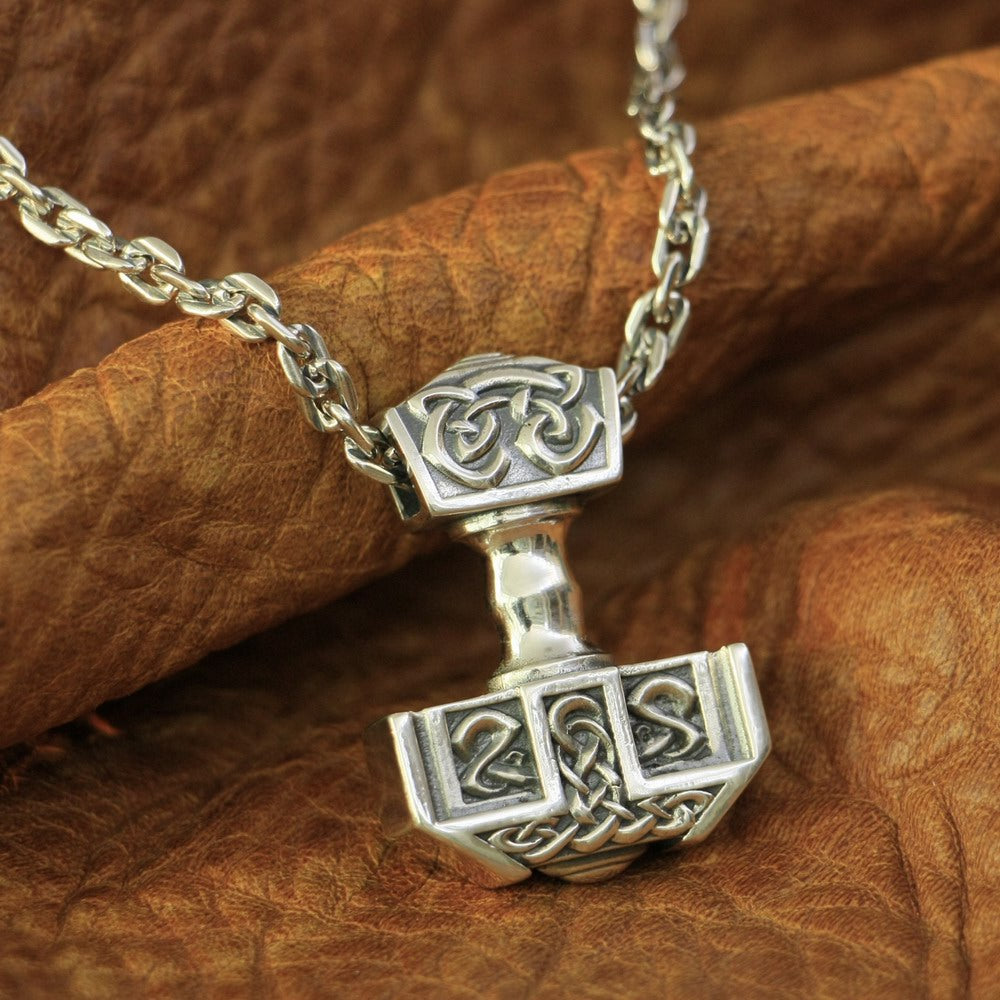
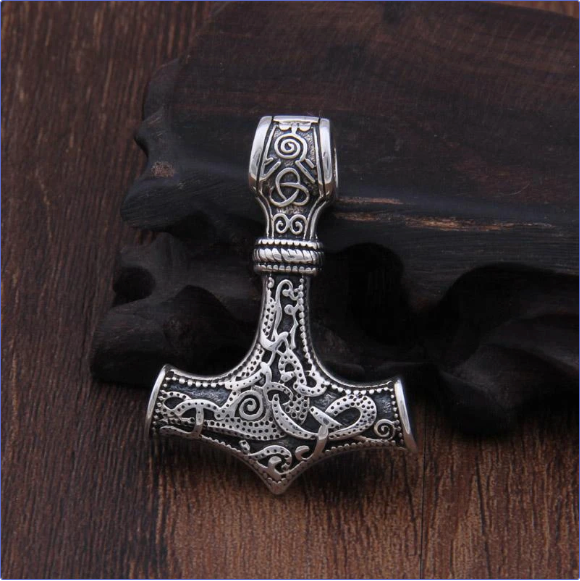
Archaeological discoveries reveal numerous hammer-shaped pendants throughout Scandinavia and other regions influenced by Norse culture. These objects demonstrate the importance of Thor's hammer as a personal and religious symbol.
People wear Mjölnir pendants as expressions of devotion to Thor and as symbols of protection, strength and belonging. Thor represents a particularly accessible deity within the Norse pantheon. He protects farmers, travellers, warriors and ordinary communities. His association with thunder, rain and fertility also connects him to agricultural prosperity and the renewal of nature.
Mjölnir therefore embodies several essential values:
- Strength: The courage and power to overcome adversity.
- Protection: Defence against danger and destructive forces.
- Justice: The punishment of chaos and the preservation of order.
- Fertility: The blessing of the land, agriculture and the continuation of life.
- Spiritual identity: A visible expression of Norse religious beliefs and cultural heritage.

Mjölnir and Ragnarök: The Final Battle
Ragnarök represents one of the most dramatic events in Norse mythology: the great battle that brings the destruction of the existing cosmic order and the emergence of a renewed world. During this apocalyptic confrontation, Thor faces his greatest enemy, Jörmungandr, the enormous Midgard Serpent that encircles the world.
Armed with Mjölnir, Thor confronts and kills the serpent. However, its venom proves fatal. After defeating his enemy, Thor manages to walk nine steps before falling.
This encounter illustrates one of the fundamental themes of Norse mythology: even the most powerful Gods remain subject to fate.
Thor's final battle demonstrates his courage, determination and commitment to defending the world. Mjölnir remains the instrument through which he confronts the forces of destruction, even when the outcome of the cosmic struggle is inevitable.

Mjölnir in Modern Culture and Contemporary Norse Heritage
Mjölnir continues to enjoy extraordinary recognition in contemporary culture. Modern literature, films, comics and video games introduce Thor and his hammer to audiences around the world. Marvel Comics, in particular, develops a distinctive interpretation of Mjölnir, presenting it as a weapon that only individuals considered worthy can lift. In fact, this requirement never existed in the sagas, which only stated that the hammer was so heavy that very few were able to lift it, which allowed it to be stolen by the jotunn Thrym.
Mjölnir remains an important symbol in contemporary Norse-inspired spirituality, including Heathenry, as well as in historical reenactment, jewellery, tattoos and Scandinavian cultural heritage.
From its extraordinary creation by dwarven craftsmen to its decisive role in Ragnarök, Mjölnir occupies a fundamental position in Norse cosmology and faith.
Mjölnir reminds us that true power is not simply the ability to destroy, but also the responsibility to protect the world and preserve the balance of life.

Bibliographical references
1. Lindow, John (2002). Norse Mythology: A Guide to the Gods, Heroes, Rituals, and Beliefs. Oxford University Press. ISBN: 9780195153828.
2. Larrington, Carolyne, translator (2014). The Poetic Edda. 2nd edition. Oxford University Press. ISBN: 9780199675340.
3. Sturluson, Snorri (1987). Edda. Translated by Anthony Faulkes. Everyman Classics. ISBN: 9780460876162.