
Midgard is the realm of humanity, the world where men and women live, work, fight, and build their societies. It occupies a central position in the Norse cosmos, serving as a bridge between the divine realm of Asgard and the chaotic wilderness inhabited by giants. More than simply the Earth, Midgard represents order carved out from chaos, protected by the Gods yet constantly threatened by powerful forces beyond its borders.

The Meaning of Midgard
The name Midgard comes from the Old Norse Miðgarðr, meaning "Middle Enclosure" or "Middle Yard." The term combines mið (middle) with garðr (enclosure, fence, or fortified settlement).
This name reflects an important aspect of Norse thought. The world of humans was not seen as an endless wilderness but as a protected space surrounded by hostile forces. A fenced enclosure symbolized safety, civilization, and community. Outside the enclosure lay danger, represented by untamed nature, monstrous beings, and the giants of Jötunheim.
The English word "midgard" is closely related to the Old English middangeard, demonstrating that this concept existed throughout the Germanic world long before the Viking Age.

The Creation of Midgard
According to the Norse creation myth, the universe began with the meeting of fire from Muspelheim and ice from Niflheim in the primordial void known as Ginnungagap. From this interaction emerged the giant Ymir, whose descendants became the race of giants.
Eventually, Odin and his brothers Vili and Vé slew Ymir and fashioned the world from his enormous body.
The creation of Midgard involved several remarkable transformations:
His flesh became the land.
His blood formed the oceans and lakes.
His bones became mountains.
His teeth and broken bones became rocks.
His skull formed the sky.
His brain became the clouds.
To protect humanity, the Gods used Ymir's eyebrows to create a great circular wall around the inhabited world. This enclosure became Midgard, separating the realm of mortals from the dangerous lands of the giants.
The image of a protected human world built from the remains of a primordial being reflects one of the central themes of Norse mythology: order established through sacrifice and struggle.

Humanity's Home
Midgard is the home of all human beings. Unlike the immortal Gods of Asgard or the supernatural inhabitants of other realms, humans possess limited lifespans and must rely on courage, wisdom, and cooperation to survive.
The first humans, Ask and Embla, were created by Odin and his brothers from two pieces of driftwood found along the shore. Odin granted them life and spirit, Vili gave them intelligence and emotion, while Vé bestowed speech, hearing, and sight.
Their descendants populated Midgard, establishing farms, villages, kingdoms, and eventually the societies known to the Vikings.
Human life in Midgard was viewed as both meaningful and fragile. Fate, known as wyrd or urðr, influenced every person's life, yet individuals were expected to meet challenges with honor regardless of the outcome.

Midgard Within the Nine Realms
Norse cosmology traditionally describes Nine Realms, all connected by the immense world tree Yggdrasil.
Among these realms are:
Asgard, home of the Aesir Gods.
Vanaheim, home of the Vanir Gods.
Jötunheim, land of the giants.
Alfheim, realm of the Light Elves.
Svartalfheim or Nidavellir, home of the dwarfs.
Muspelheim, realm of fire.
Niflheim, realm of ice and mist.
Hel, the underworld of many of the dead.
Midgard, the realm of humanity.
Although separated into different realms, travel between them was possible for Gods and certain supernatural beings. Odin frequently journeyed throughout the cosmos in search of knowledge, while Thor regularly traveled from Asgard into Midgard and Jötunheim.
This interconnected universe reflects the Norse belief that no realm existed in complete isolation.

The Bifrost Bridge
The primary connection between Midgard and Asgard is the Bifrost, the rainbow bridge guarded by the watchful God Heimdall.
Bifrost allows the gods to visit Midgard while preventing hostile forces from easily invading Asgard. Heimdall constantly watches for approaching enemies and will sound the mighty Gjallarhorn when Ragnarök begins.
The rainbow itself likely inspired the concept of Bifrost, although in Norse mythology it is portrayed as a supernatural bridge capable of bearing the weight of the Gods but destined to collapse during the final battle.
The existence of Bifrost emphasizes that Midgard is never entirely separated from divine influence.

Jörmungandr: The Midgard Serpent
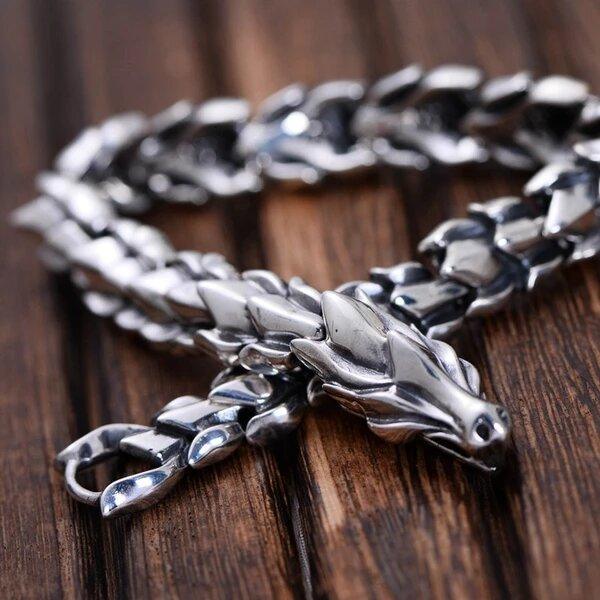
Perhaps the most famous guardian—and threat—to Midgard is Jörmungandr, the Midgard Serpent.
One of Loki's monstrous children, Jörmungandr was cast into the ocean surrounding Midgard by Odin. There the serpent grew to such enormous size that it encircled the entire world and grasped its own tail.
This image has fascinated scholars for centuries. The serpent forms both a boundary and a constant reminder that chaos lies just beyond human civilization.
Thor's repeated encounters with Jörmungandr are among the most celebrated myths in the Norse tradition. These include:
Thor's attempt to fish up the serpent while sailing with the giant Hymir.
Their final confrontation during Ragnarök.
In the last battle, Thor succeeds in killing Jörmungandr but walks only nine steps before dying from the serpent's deadly venom. Neither champion survives, illustrating the tragic heroism common in the Norse cosmos.

Midgard During Ragnarök
The peace of Midgard ultimately comes to an end during Ragnarök, the prophesied destruction of the cosmos.
The sequence begins with the terrible Fimbulwinter, a prolonged winter marked by violence and social collapse. Brothers fight brothers, kingdoms fall into chaos, and moral order disintegrates.
Soon afterward:
Fenrir breaks free of his chains.
Jörmungandr rises from the sea.
Loki escapes imprisonment.
The giants march toward Asgard.
The rainbow bridge Bifrost shatters.
The battles that follow devastate both Gods and humanity.
Yet Ragnarök is not merely an ending. After the destruction, the world rises anew from the sea, greener and more fertile than before.
Several human survivors, Líf and Lífthrasir, emerge from the shelter of Hoddmímis Holt. They repopulate the renewed Midgard, symbolizing hope and renewal after catastrophe.
This cycle of destruction and rebirth distinguishes Norse mythology from many traditions that portray the end of the world as final.

The Symbolism of Midgard
Midgard represents much more than the physical Earth. It symbolizes humanity's place between opposing forces.
On one side stand the Gods, representing order, law, and protection. On the other are the giants and monsters, embodying chaos, destruction, and untamed nature.
Humans occupy the middle ground, constantly balancing these opposing influences.
This worldview mirrors the realities faced by Viking Age societies. Communities existed in landscapes that could be both generous and unforgiving. Storms, famine, disease, and warfare were ever-present threats, yet people continued to build homes, raise families, and create lasting cultures.
The enclosed nature of Midgard also reflects the importance of community. Survival depended on cooperation within the settlement while remaining vigilant against dangers beyond its borders.

Midgard in Modern Culture
Modern interpretations often portray Midgard simply as Earth, but the original Norse concept is richer and more symbolic. It represents the human condition itself—a protected yet vulnerable world where courage, honor, and perseverance matter despite the inevitability of death.
The enduring appeal of Midgard lies in its universal themes. Humanity exists between creation and destruction, safety and danger, hope and uncertainty. These ideas remain as relevant today as they were to the Viking storytellers who first preserved the myths over a thousand years ago.

Bibliography
Lindow, John. Norse Mythology: A Guide to Gods, Heroes, Rituals, and Beliefs. Oxford University Press, 2002. ISBN: 9780195153828
Simek, Rudolf. Dictionary of Northern Mythology. D. S. Brewer, Revised Edition, 2007. ISBN: 9780859915137
Byock, Jesse (Trans.). The Prose Edda. Penguin Classics, 2005. ISBN: 9780140447552