
Asgard Before the Walls
In the early days of the cosmos, Asgard stood as the stronghold of the Æsir, the ruling tribe of Norse Gods. Though elevated above Midgard (the world of humans), Asgard was not yet secure. The Gods lived under constant threat from the jötnar—the giants—ancient beings who embodied raw, untamed forces of nature. While not inherently evil, the giants were frequently hostile to the Gods’ attempts to impose order on the cosmos.
Realizing their vulnerability, the Æsir agreed that Asgard needed fortifications. Not merely symbolic walls, but defenses strong enough to withstand giant attacks and secure the divine realm for generations. What followed was not a careful architectural project, but a bargain that would spiral into one of the most famous acts of divine trickery in myth.

The Mysterious Builder’s Offer
According to the Prose Edda, a stranger arrived in Asgard shortly after the Gods had settled their realm. He claimed to be a master builder and offered to construct an impregnable wall around Asgard in a single winter—an astonishing feat, even by divine standards. His price, however, was outrageous.
In exchange for his labor, the builder demanded the Goddess Freyja in marriage, the sun, and the moon. Freyja was - and is - one of the most beloved Goddesses, associated with love, fertility, and magic, while the sun and moon were essential cosmic forces. Handing them over would destabilize the universe itself.
The Gods were understandably outraged, but Loki, ever persuasive, suggested negotiation. He proposed a counter-deal: the builder could have his reward only if he completed the wall alone, without assistance, and finished it within a single winter. If he failed, he would receive nothing. Confident to the point of arrogance, the builder agreed, for he had a secret weapon: his horse.

The Power Behind the Work
Construction began immediately, and it soon became clear that the Gods had made a grave miscalculation. The builder’s strength was immense, but his true advantage lay in his horse, Svaðilfari. This stallion hauled massive stones with supernatural ease, performing most of the heavy labor. Night after night, the walls rose higher and stronger, fitted together with impossible precision.
As winter wore on, panic spread among the Æsir. With only days remaining before the deadline, the wall was nearly complete. The Gods realized that they were on the brink of losing Freyja, the sun, and the moon, all because of a bargain Loki had convinced them to make.
When confronted, Loki did what he always did best: promised to fix it.

Loki’s Most Bizarre Deception
Rather than confronting the builder directly, Loki chose sabotage. One night, he transformed himself into a mare (a female horse) and lured Svaðilfari away from the construction site. Enchanted and distracted, the stallion chased Loki deep into the forest, abandoning his work.
Without his horse, the builder could not finish the wall in time.
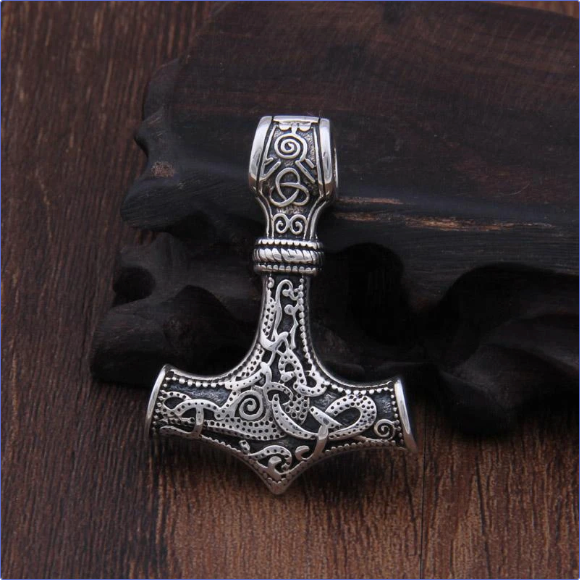
When the deadline passed, the walls were still incomplete. Thus, as per the terms of the agreement, the builder would receive no compensation. Furious, the builder revealed his true nature as a giant and attacked the Æsir. This time, brute force answered deceit: Thor struck him down with Mjölnir, shattering the giant's skull and his ambition of marrying Freyja and owning the sun and the moon. Asgard was saved, but Loki’s trickery was not without consequence.

The Birth of Sleipnir
Loki eventually returned to Asgard, but he did not come alone. His transformation had lasting effects. Months later, Loki gave birth to Sleipnir, an eight-legged horse of unmatched speed and strength. Sleipnir would become Odin’s mount, capable of traveling between worlds and even into the realm of the dead.
This strange outcome underscores a recurring theme in Norse mythology: solutions often carry unforeseen costs. Loki’s deception saved the Gods, but it also reshaped him, reinforcing his role as a liminal figure, neither hero nor villain.

Order Built on Deceit
The walls of Asgard stand as a symbol of divine order, but its foundations relied on Loki’s moral flexibility.
Loki’s role is particularly revealing. Although he was responsible for convincing the Gods to take the terrible bargain, he also managed to make it work, even though he had to use some very unconventional means. Yet, every lie pushes Loki further from the Æsir, foreshadowing his eventual role in Ragnarök, where he will openly opose the Gods, after a lifetime of mischief and punishment.

The creation of Asgard’s walls refuses simple morality. The builder is wronged, yet he sought to wrong the Gods first. Loki convinces the Gods to take the bargain, potentially dooming the cosmos, but also solves the problem through more mischief.
In that ambiguity lies the power of Norse mythology. The walls do not represent perfect safety, but a fragile order, held together by compromise, violence, and clever lies, much like the world itself.

Bibliographical References
Sturluson, Snorri. The Prose Edda. Translated by Jesse L. Byock. Penguin Classics, 2005. ISBN: 978-0140447552
Larrington, Carolyne (trans.). The Poetic Edda. Oxford World’s Classics, 2014. ISBN: 978-0199675340
Gaiman, Neil. Norse Mythology. W. W. Norton & Company, 2017. ISBN: 978-0393609097